


NEWPORT NEWS—In 2022, Virginia released the Virginia Energy Plan, which outlined the commonwealth’s embrace of nuclear and hydrogen systems as a way to provide reliable, affordable, and clean energy to all Virginians.
In support of this, the Dominion Energy Innovation Center (DEIC) created its SPARK Virginia Program and brought it to Jefferson Lab on Tuesday, May 16, offering a full day of micro-conferences focusing on advancing and supporting energy innovators.
“SPARK 757 is a unique opportunity to bring together industry leaders, researchers, and entrepreneurs to accelerate Virginia’s clean energy transition,” said Braden Croy, DEIC program director. “By building an innovation ecosystem, we can create solutions that will help reduce emissions and empower entrepreneurs to move our energy economy forward.”
The day kicked off with “Getting Launched in the Energy Entrepreneur Ecosystem,” which focused on the resources that are available to energy entrepreneurs across Go Virginia Region 5, which includes Hampton Roads. Panelists Marla Schuchman, chief innovation officer at Jefferson Lab; Kim Middleton, senior licensing specialists at NASA Langley Research Center; Tim Ryan, director of TEaKTOR Technology Innovation Center and StartWheel; and Croy explored how and what technology is moving out of the region’s globally recognized labs and where opportunities exist for entrepreneurs to partner, enhance, and commercialize advanced energy intellectual property.
The ”Market Discovery Event—Tech Transfer Explorations” discussion keyed on Jefferson Lab and NASA Langley Research Center’s partnership with DEIC to identify a set of advanced energy technologies that are ready to begin their commercialization journey beyond the lab. Panelists Dr. Kevin Jordan, diagnostics development group leader at Jefferson Lab; Dr. Sang Choi, senior lead scientist at NASA Langley Research Center; and Dr. Choel Park, senior research at NASA Langley Research Center conducted an open design thinking workshop to put the best research minds together with the best industry minds to find lab-to-market pathways.
The “Virginia Energy Innovation Pathways” brought together investment experts from the Virginia Innovation Partnership Corporation (VIPC) and other regional venture capitalists to discuss the various early-stage technology funding pathways available to Virginia startups. Panelists Marco Rubin, senior investment director at VIPC; Sean Mallon, vice president of commercialization at VIPC; and Adam Sledd, executive director of Dominion Energy Innovation Center focused on how energy entrepreneurs can pursue early-stage funding through the Commonwealth Commercialization Fund, Federal SBIR/STTR Awards, and ultimately equity investment from Virginia Venture Partners and others.
“Virginia as a Clean Hydrogen Leader” focused on the fact that Virginia is experiencing a hydrogen awakening and is distinguishing itself as a national leader in the startup, operation, and support of clean hydrogen companies. The panel of Lisa Carter, director of Innovation, Sustainability, and Strategic Risk at Dominion Energy; Ally Islin, engineer with Independence Hydrogen; and Mallory Tuttle, associate director of Outreach and International Affairs at the Virginia Tech Newport News Center shared news about the development of the Virginia hydrogen hub and how entrepreneurs can tap into the Tech Center’s hydrogen learning lab and testbed that is being developed with support from state, federal, and local entities.
“Hampton Roads has positioned itself as a leader in clean energy production and transition,” said Tuttle. “Expanding our focus to include offshore wind, hydrogen, and additional new(er) energy technologies is going to position the region as a major player in the global clean energy industry. Hydrogen as a fuel source is expected to directly address local energy demand, resiliency needs, and decarbonization efforts. There is a lot of energy around energy in Hampton Roads and hydrogen is going to continue to fuel that interest (all puns intended).”
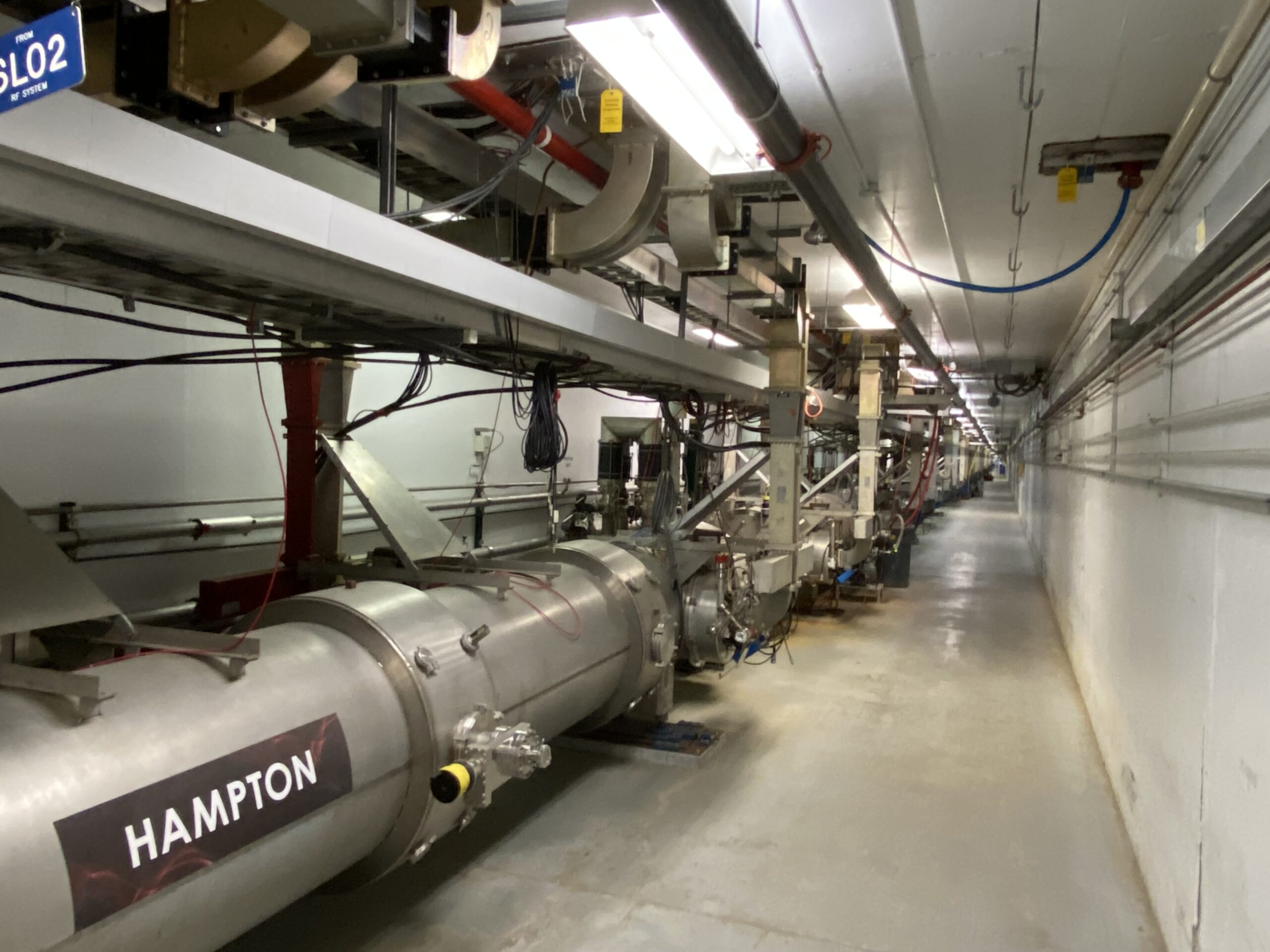
At the midway point in the day, interested parties were invited to take a tour of Jefferson Lab and the accelerator. Guests were taken underground for a behind-the-scenes look at the Continuous Electron Beam Accelerator Facility (CEBAF) and experimental halls. During the two-hour tour, researchers and commercialization experts held discussions about the science and engineering of particle acceleration, cryogenics, and research that is pushing the boundaries of physics and science.
“Our research focuses on exploring the forces and subatomic particles within the nucleus, but the technologies and engineering systems we develop to do that work may have exciting applications outside of our lab,” said Marla Schuchman, chief innovations officer at Jefferson Lab. “We are thrilled to work with Dominion Energy Innovation Center to identify paths for our technologies to advance Virginia’s clean energy future.”
Following the tour, the SPARK 757 Energy Innovation Showcase and Pitch Competition was held. $8,500 in unrestricted innovation grants was up for grabs as energy entrepreneurs showcased their innovations and answered three questions: “So What?” “Who Cares?” and “Why You?” Representatives from Edenic Energy, Ellexco, Helix Hydrogen, Mehrdel LLC, N-Smart Inc., NearStart Fusion, Scale Materials, and Tamer Space were on hand to pitch their companies and explain how their products can help push forward the clean energy of the future.
Topping the day off was the “Envisioning the Energy of the Future” panel, which focused on what’s next and where do we go from here in looking forward to a decarbonized, highly integrated future to answer the questions: Why nuclear, why hydrogen, and why the two systems should be joined?
“As a leader in advanced energy systems on Earth and beyond, NASA Langley Research Center is excited to partner with other industry leaders at SPARK 757,” said Michelle Ferebee, acting director of the Strategic Partnerships Office at NASA Langley Research Center. “The Administration’s pursuit of advanced nuclear and hydrogen propulsion systems aligns with our vision of advancing our country’s energy transition. We wish to see more technology pulled out of the lab and into the market, and this event provides a unique opportunity to showcase the great work being done by our researchers and partners to advance this goal.”
At the end of the evening, the pitch contest winners were announced. N-Smart Inc. was awarded the top prize of $2,500; Edenic Energy from Portsmouth brought home $2,000; Scale Materials received $2,500; Ellexco came away with $750; and Helix Hydrogen, Tamer Space, NearStar Fusion, and Mahrdel, LLC were each given $500.
Edenic Energy is a Portsmouth-based company that provides software and hardware to outdated buildings, primarily in economically disadvantaged communities, so owners can make cost-effective energy improvements. The company currently has six pilot programs and plans to use the grant award to accelerate product development and onboard more commercial buildings.
“It feels like a breath of fresh air to have won because as an early-stage startup, these opportunities are what keep us going,” said Thomas Hunter, the company’s founder. “Innovation is what moves the needle to solve these hard problems in this industry. With new technologies, we are finding out that there are better ways to mitigate climate risk, increase profit, and ultimately impact the health of people.”
Special thanks to the Innovations Pitch Competition judges, Vida Williams, chief digital and branding officer, Virginia ABC; Todd Moring, lead advanced mechanical systems engineer, GE Aerospace; Jeff Vance, sales and strategic accounts, Palo Alto Networks; and Marty Kaszubowski, technology venture consultant.
I thought Tuesday was exactly what we were hoping to see,” said Adam Sledd, executive director of Dominion Energy Innovation Center. “Virginia has outstanding research talent, and more of that talent that people realize is working on the kind of next generation energy solutions we desperately need. SPARK is a program we created to bring all these various pieces together—the researchers, the entrepreneurs, the funders, and the supporters—and get them all talking together about what they can do to help Virginia’s energy grid in the coming years. I think what we saw was that the talent is here to create all the reliable, clean energy we want to have in the commonwealth, we just need to keep supporting the people who are building these technologies.”