

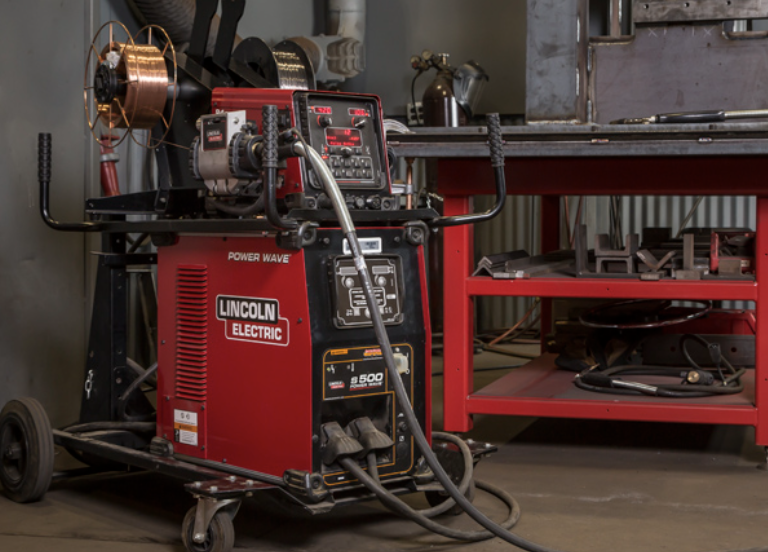

Shipyard Suppliers is intended to be a series of articles about local businesses that are supplying materials and services to Newport News Shipbuilding to facilitate the construction of next-generation submarines and aircraft carriers supplied to our country’s Navy.
In this fourth installment, the Peninsula Chronicle spoke with Jeff Naswadi, a technical sales representative specializing in military applications for Lincoln Electric.
Peninsula Chronicle: Tell us about Lincoln Electric.
Jeff Naswadi: Lincoln has been around since 1895. It’s a Cleveland, Ohio-based company started by two brothers, John and James Lincoln. John was the brains behind it. He held at least a few hundred patents in his lifetime. James was the brawn of the company. He took all of the things that John created, brought them to market, and made them sellable. James was kind of the face of the company and led the company into the 1960s. Lincoln Electric was privately owned until 1995 and now we are a multinational corporation doing about $3 billion a year in revenue.
PC: What do you do for the Newport News Shipyard?
JN: We started working with the shipyard in the 1950s, basically selling welding rods, stick welding, or what we call SMAW (shielded metal arc welding). Back then, we would sell them welding rod, they would use it, and that was the extent of the relationship. Then we got into supplying welding products as the technology changed. As welding technology changed, we changed and sold wire and products. That went on until about 2005 when Newport News Shipbuilding had a change in their management philosophy. Before, it was kind of closed off. They made their own equipment, they would buy from suppliers, but they didn’t really rely on suppliers too much to develop new things for them. Starting in 2005, we brought in some commercial equipment and honed it in for their needs, and now there’s a strategic partnership between Lincoln and the shipyard. They get the benefit of seeing products before they are launched, and we get the benefit of using the shipyard as a really big test ground. We get to learn about survivability. If it works in that environment, then we can use that information, that engineering knowledge, to then make products that work well in lots of other applications. So, it’s really grown into a robust relationship.
PC: Based on your name, one might assume you supply electrical support.
JN: One of the first things that John Lincoln had a patent on was DC-generated motors. That bled over to using engine drives to power a stator generator to power welding equipment, and the name kind of just stuck over the years.
PC: So, you are primarily a welding supply company?
JN: Yes, but we’ve gotten into a lot of automation, robotics, and mechanized equipment. It’s really a pretty diversified portfolio. Back in 2005, the shipyard brought in the best products that were commercially available in the welding world and we ended up winning that out. They asked for tweaks, so we developed some specific waveforms for welding to help them accomplish what they needed to do. We’ve collaborated on how we use our wire feeders in the welding machines and now we’re working on a big orbital project where we made some special equipment to help with submarine construction and particular carrier situations where there are tight spaces where they are trying to weld particular joints. So, our relationship has grown and we’re starting to roadmap out things like codebots, and automation, so our relationship has really grown us into a really robust, critical path supplier for the shipyard. One of the core things they do is weld plate, so we’re definitely involved in that.
PC: Do you also service the equipment you provide?
JN: Newport News Shipbuilding is a little different than most accounts. They’re big enough where they have an onsite service group. That’s the department with the mechanics. My job is to support them. They have people there that work on the equipment, fix it, maintain it, PM (preventive maintenance) it, and I’m the front-line support when they have questions like, “Hey, I did this diagnostic and I need a little help.” I’ll go in and help troubleshoot issues or get them connected with the right technical person if I can’t help them. Most places don’t do that. Most places would send equipment off to a repair shop for something specific, but the shipyard has enough equipment needs where they have a whole department to keep all their equipment running.
PC: What do you think about the multi-buy contracts?
JN: To get a robot qualified to do multi-fast welding with NAVSEA is a big effort. There’s more appetite to do that if you know there will be stable orders for the submarine or carrier work that they’re going to be done on.
PC: Can other businesses come to you for assistance or are you primarily here to support the shipyard?
JN: Newport News Shipbuilding is the driver of things, but I work with Liebherr and Hampton Road Machine, too. Anybody that does fabrication intersects with Lincoln at some point. So, we support that. We don’t have a retail store or anything like that down here, but what we do definitely impacts other people’s businesses. For the industrial distributors of gases and welding products, that’s a big source of their product portfolio and their revenue.
PC: Anything else you’d like to share?
JN: We’re definitely strong and getting stronger. We have a robust relationship that we’ve built with the shipyard over the years and there’s a lot going on, especially right now. The Navy is anxious to take delivery of their ships and we’re in the thick of it because right now the slow point in construction is welding. So, the shipyard is looking for anything they can do to speed things up and we’re here to provide support for that.